The Challenge
The project was developed during HackUPC together with Karl Jahnel, Donato Monti, and Daniel Banov. The challenge was proposed by Inditex, where participants were given a large dataset of product images and were tasked with building a similarity matching system.
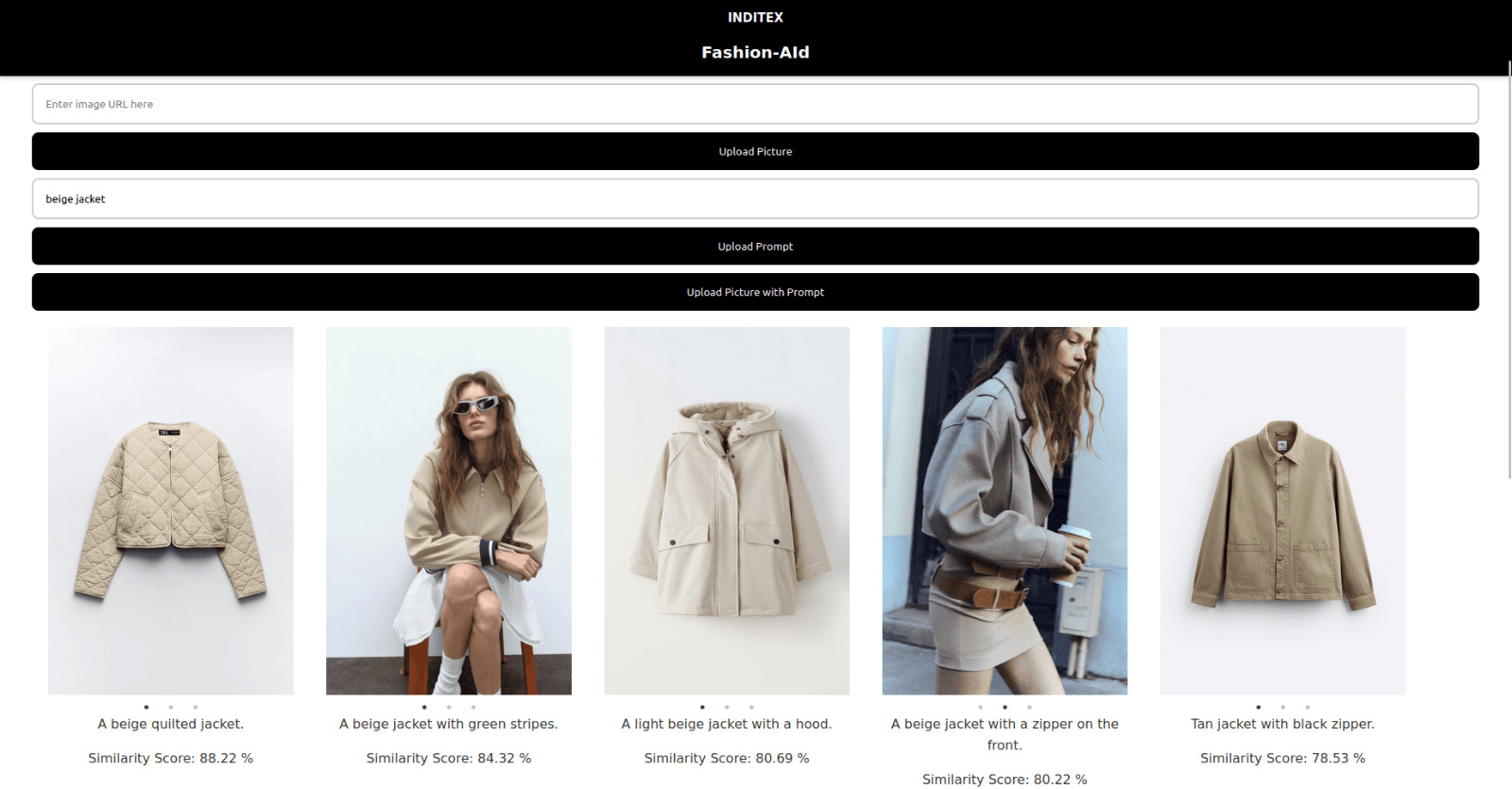
The goal was clear: create a system that could understand fashion images and recommend similar items from a database. Users should be able to upload a product image or describe a product in text, and the system would return the closest matching items with similarity scores.
The Solution
We built FashionAId, an AI powered clothing recommendation system that uses a RAG (Retrieval Augmented Generation) architecture to match user inputs with products in the database.
The system works by converting fashion images into high dimensional vector embeddings using the tiny Llava 1.5b model. These embeddings capture the visual and semantic features of each product, turning images into a mathematical representation that can be compared efficiently.
All product embeddings are stored in ChromaDB, a vector database optimized for similarity search. When a user uploads an image or provides a text description, we convert their input into the same embedding space and use cosine similarity to find the closest matches in the database.
The backend is built with Python and Flask, handling the image processing, embedding generation, and similarity search. The frontend is a React application that provides an intuitive interface for uploading images, viewing results, and exploring recommendations.
The Result
Each recommendation includes the product description and a similarity score, giving users both visual and textual information about why items match their input. The system can handle both image and text queries, making it flexible for different use cases.
Our project submission received an honorable mention from Inditex's jury, recognizing the technical approach and user experience we delivered in just 24 hours. The hackathon was a great experience in rapid prototyping, working with computer vision models, and building a complete system from scratch.
Check out our Devpost submission for more details.